

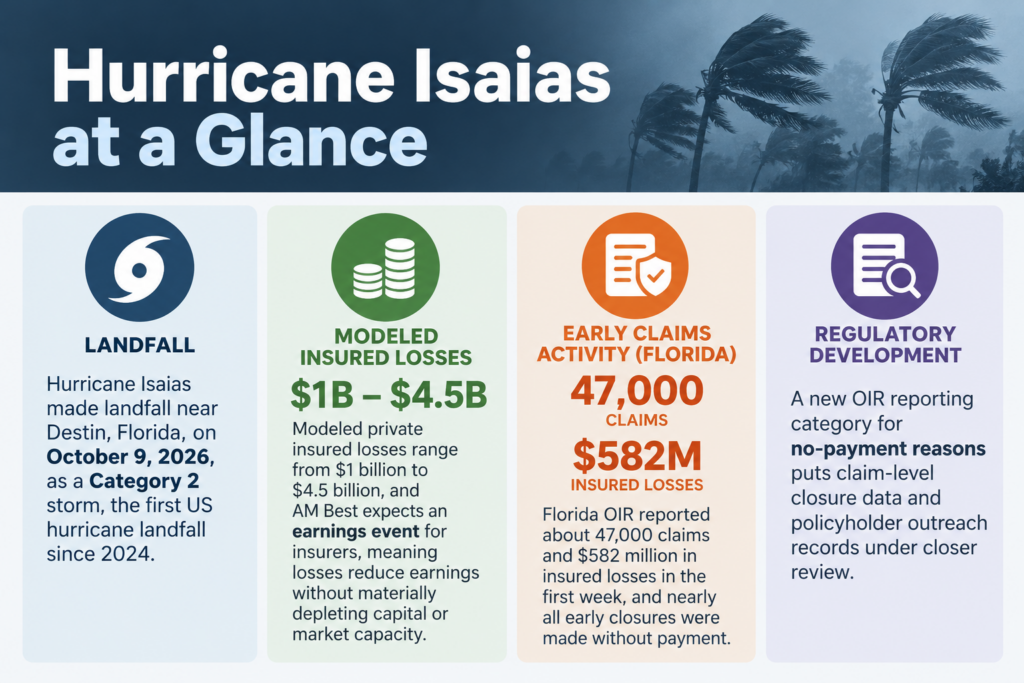
Hurricane Isaias made landfall near Destin, Florida, on the evening of October 9 as a Category 2 storm with 105 mph sustained winds. It was the first hurricane to strike the continental US since Milton in 2024, and the latest first hurricane of an Atlantic season on record. By most financial measures, the industry absorbed it well. AM Best has described Isaias as an earnings event, with losses well below the level that would threaten capital or solvency, and Gallagher Re expects it to have little effect on most carriers’ reinsurance renewals.
For carrier and MGA leadership teams, the more useful lessons sit in the operational record the storm is creating. Isaias is the first hurricane reported under Florida’s new category for claims closed without payment, and the early data says a lot about how claim intake, exposure data, and policy wording behave under real conditions. Because the loss is moderate, carriers have a rare chance to study those mechanics without the pressure of a balance sheet event.
How Much Did Hurricane Isaias Cost Insurers?
Modeled industry loss estimates landed in a fairly tight band. Verisk put insured onshore property losses at $1 billion to $2 billion. Cotality estimated $2 billion to $3 billion for wind and storm surge. Karen Clark & Company came in at $3 billion, and Moody’s RMS Event Response published a range of $2.5 billion to $4.5 billion with a best estimate of $3.5 billion. Before landfall, BMS had been projecting $4 billion to $6 billion.
The geography of the claims is where Isaias departs from the usual pattern. The strongest winds were recorded near the western eyewall around Pensacola, according to AM Best and weather reports, which pushed water away from the coast and limited surge losses. Claims followed the wind. As of mid-October, Santa Rosa County had produced nearly 22,900 claims and Escambia County close to 13,700, while Okaloosa and Walton counties, where the eye came ashore, accounted for about 6,000 combined, per Florida OIR figures reported by Insurance Journal.
For anyone who managed exposure aggregation around the forecast landfall point, that distribution is a useful reminder. Accumulation views keyed to the projected track can understate the counties that end up driving claim volume, especially when a storm’s wind field behaves atypically.
Why Do the Hurricane Isaias Loss Estimates Differ?
Executives reading the range of estimates should keep in mind that each modeler defines insured loss a little differently. KCC’s figure includes residential, commercial and industrial property, autos, and business interruption, while excluding boats, offshore property, and NFIP losses. Verisk’s estimate excludes loss adjustment expenses and tornado damage. Moody’s RMS folds precipitation-induced inland flooding and NFIP-related losses into its total.
Each of those choices is defensible. They do mean that a carrier comparing its own early incurred estimate to an industry figure needs to know which components it is matching. A company that books LAE and tornado-related losses against the event will naturally run above a Verisk-style benchmark, and one with meaningful commercial exposure along the Panhandle coast will see business interruption arrive later than dwelling claims. The quality of that comparison depends heavily on how cleanly a carrier’s own system separates loss components by cause, coverage, and peril.
Why are so Many Hurricane Isaias Claims Closing without Payment?
Florida OIR’s Hurricane Isaias data call showed roughly 47,000 claims and $582 million in estimated insured losses within the first week. Most were residential property claims. About 12% had been closed by October 15, and almost all of those were closed without payment.
This year OIR added a reporting category for the reason a claim closes without payment, and “administrative reasons” was the most frequently cited. That label can cover a claim withdrawn by the policyholder, a duplicate filing, or an inability to reach the insured. Other common reasons included damage below the deductible and flood damage that fell outside the policy.
The field context explains much of the early pattern. A Pensacola-area agent told Insurance Journal that many policyholders with downed trees filed quickly and then learned the tree had not damaged the home, that tree removal fell outside their homeowners coverage, or that the loss sat below their deductible.
For a regulator, a large population of claims closed for administrative reasons is a data point worth examining. Florida OIR has noted that it audits and examines insurers’ catastrophe claims handling for compliance with state law and policy terms. A carrier that can show, claim by claim, why a file closed and what contact attempts were made is in a much stronger position than one that has to reconstruct that history from adjuster notes after the fact.
A few operational questions follow from that:
- Are closure reasons captured as structured, reportable values at the claim level, or do they live in free-text notes?
- Can the closure reason taxonomy map cleanly to the categories a regulator requests, including new ones added mid-cycle?
- When an insured cannot be reached, is every outreach attempt logged with date, channel, and outcome?
- How are duplicate claims identified and linked, especially when a policyholder reports through more than one channel?
- When a claim closed without payment reopens, which is common after hurricanes as hidden roof and interior damage surfaces, does the reporting reflect the full history?
How Does Hurricane Isaias Compare to Hurricane Sally?
Insurance Journal compared Isaias with Hurricane Sally, which struck nearly the same coastline in 2020 and produced 72,000 claims and $577 million in losses within six weeks. One week in, Isaias had already passed Sally’s six-week dollar figure on far fewer claims, a ratio that will keep moving as commercial and business interruption claims develop.
KCC’s description of the damage points toward a significant commercial claims load, with hotels, grocery stores, gas stations, and apartment buildings reporting roof and cladding damage, according to Insurance Business. Those claims tend to arrive later, carry larger severities, and involve business interruption calculations that take time to settle.
Policy wording questions are also on the way. With 21 tornadoes confirmed across the Southeast, brokers expect questions about whether named storm or hurricane deductibles apply to tornado damage spawned by the hurricane, which depends on individual policy wording. On a $5 million commercial property with a 5% hurricane deductible, the policyholder retains the first $250,000, so the deductible trigger can be the single largest variable in a commercial claim outcome. Carriers benefit when the deductible logic configured in their systems matches the filed forms exactly, and when the system can apply different deductibles by peril within a single event.
Using a Quieter Storm as a Rehearsal
Florida’s market enters this period with more resilience than it had a few years ago. AM Best noted that the top 10 property insurers in Florida account for less than half of the state’s market, below the national average of 54%, and that the depopulation of Citizens has spread hurricane exposure across more private carriers. That diversification also means more companies, many of them newer or Florida-focused, are now responsible for producing clean catastrophe claims data under regulatory scrutiny.
Isaias gives those organizations a practical rehearsal. A post-event review that covers exposure concentration against actual claim geography, closure reason quality, outreach documentation, deductible application by peril, and the speed of regulatory data call responses will surface gaps while the stakes are moderate. The next landfall in this region may carry a much larger loss, and the operational questions will be the same ones Isaias is raising now.
Hurricane Isaias FAQ
How much did Hurricane Isaias cost insurers?
Modeled private insured loss estimates range from $1 billion to $2 billion for onshore property (Verisk) up to $2.5 billion to $4.5 billion (Moody’s RMS, with a best estimate of $3.5 billion). Karen Clark & Company estimates $3 billion. Florida OIR reported about $582 million in Florida insured losses one week after landfall.
What does it mean that Hurricane Isaias is an earnings event?
AM Best uses the term for a catastrophe whose losses reduce insurers’ earnings without materially depleting surplus or market capacity. Because Isaias falls in that category, AM Best does not expect it to trigger a capacity squeeze or a pricing surge in Florida.
Why are Hurricane Isaias claims being closed without payment?
The most common reason reported to Florida OIR is “administrative reasons,” which can include claims withdrawn by the policyholder, duplicate claims, and claims where the insured could not be reached. Other reasons include damage below the deductible and flood damage not covered by the policy.
Do hurricane deductibles apply to tornadoes spawned by a hurricane?
It depends on the policy form. Hurricane and named storm deductibles are typically tied to a defined event window, and whether tornado damage during that window triggers the deductible comes down to the specific policy wording. Twenty-one tornadoes were confirmed across the Southeast during Isaias.
How does Hurricane Isaias compare to Hurricane Sally?
Hurricane Sally struck nearly the same coastline in 2020 and produced about 72,000 claims and $577 million in losses within six weeks. Isaias produced about 47,000 claims and $582 million in losses within one week, according to Florida OIR data.
About WaterStreet Company
WaterStreet Company, based in Kalispell, Montana provides a cloud-based policy administration platform for small and mid-size property and casualty carriers and MGAs. WaterStreet brings policy administration, claims, billing and accounting, document management, and business intelligence together in a single platform hosted on Microsoft Azure, with configurable workflows and reporting built for regulated P&C operations. Through its BOSS (Back Office Support Services) division, WaterStreet also provides outsourced back-office operations support for insurers that need experienced capacity. Learn more at waterstreetcompany.com and bossbpo.com.